Workplace & Commercial Assessments

Your home isn't the only place worth measuring. Your business shouldn't be a blind spot either.

I assess offices, studios, clinics, gyms, restaurants, and small commercial spaces the same way I assess homes: instrument-verified, product-neutral, and referenced against Building Biology standards. If you run the space, you're responsible for what's in it, whether that's four employees or forty clients a week.

Who This Is For

If people spend their day in it, it's worth measuring.

Small offices and remote teams spending eight-plus hours near routers, monitors, and shared power circuits. Restaurants and retail spaces where staff work long shifts under whatever lighting was installed by the last tenant. Gyms and studios that just retrofitted LED panels without anyone checking what that did to the light in the room.

Wellness practitioners, especially. Chiropractors, massage therapists, naturopaths, functional medicine offices, acupuncturists. If your work is helping clients regulate their nervous system, the room they're doing that in matters.
Small offices and remote teams working long hours near routers, monitors, and shared power circuits.
Restaurants and retail spaces where staff work long shifts under lighting nobody has ever evaluated.
Gyms and studios that recently retrofitted LED lighting without checking what it did to the light spectrum in the room.
Why It Matters for Wellness Practices

The room carries information, whether anyone in it is paying attention or not.

Robert Becker's research established that the body runs on measurable bioelectric signaling, current the body uses for repair and regulation. Jack Kruse's framework extends that into how ambient light and non-native EMF interact with mitochondrial function and the circadian system.

A treatment room that's dim and blue-lit through the exact hours the body expects contrast, or sitting close to a router or dense wiring for hours a day, is working against the outcome you're trying to create for your client, not with it. This isn't a claim that any specific reading causes any specific symptom. It's that the environment carries information the body reads. Measuring it is how you find out what your space is actually saying.

A Recent Example

Two separate findings, two separate fixes

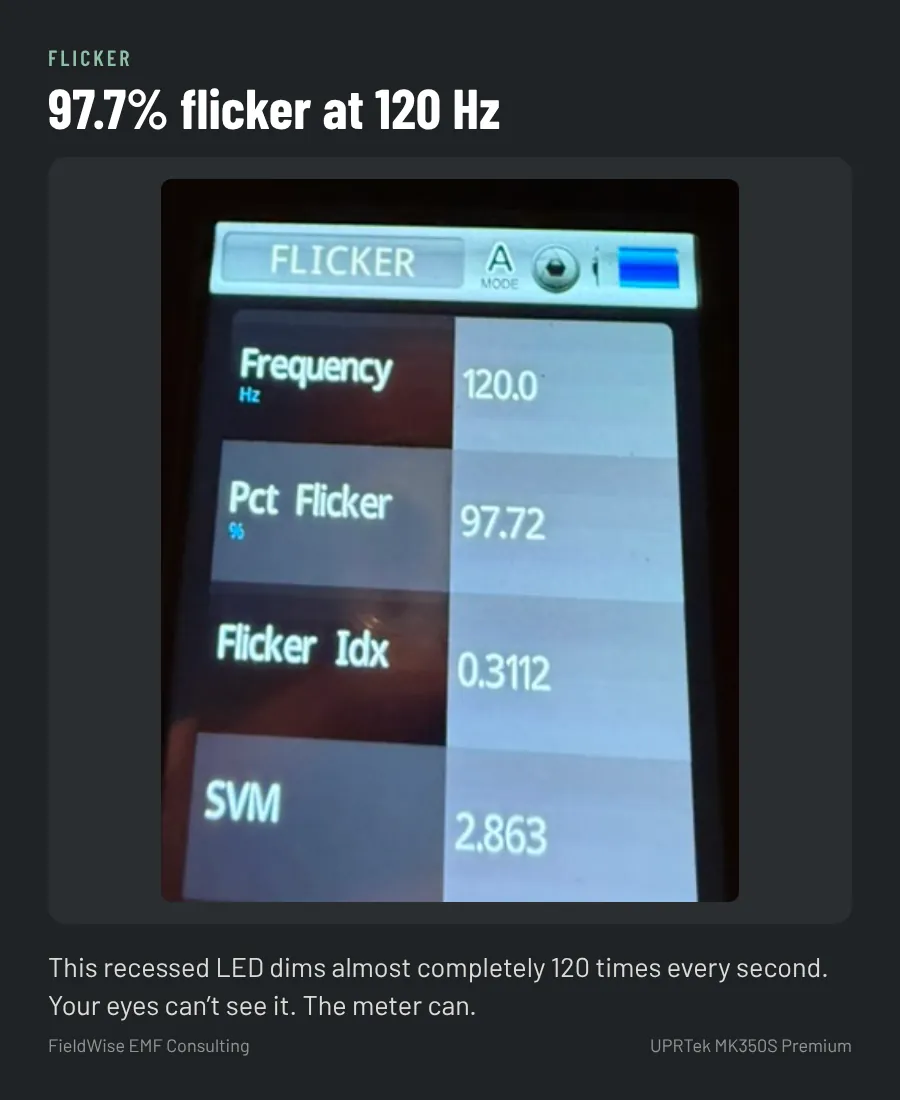
A small business owner had a Wi-Fi router mounted on the wall a few feet from where an employee sat for most of an eight-hour shift. Separately, the overhead lighting throughout the space was heavily blue-dominant with a flicker rate that showed up clearly on the spectrometer, even though it looked steady to the eye.

Finding One: RF

The RF reading at that desk came back elevated, with the kind of pulsed signal pattern that behaves less like a steady hum and more like a rapid series of sharp spikes, on and off, all day long. Relocating the router about ten feet away and out of direct line of sight brought that reading down substantially, with no change in Wi-Fi performance anywhere else in the space.

Finding Two: Lighting

That combination, blue-heavy spectrum plus flicker, is the kind of signal that keeps the nervous system in a more alert, activated state rather than allowing it to settle, especially later in the day when the body is expecting warmer, dimmer light. Swapping to warmer, non-flickering bulbs addressed that finding on its own, independent of the router fix.

What's Included

The same instrument-verified assessments, applied to your space.

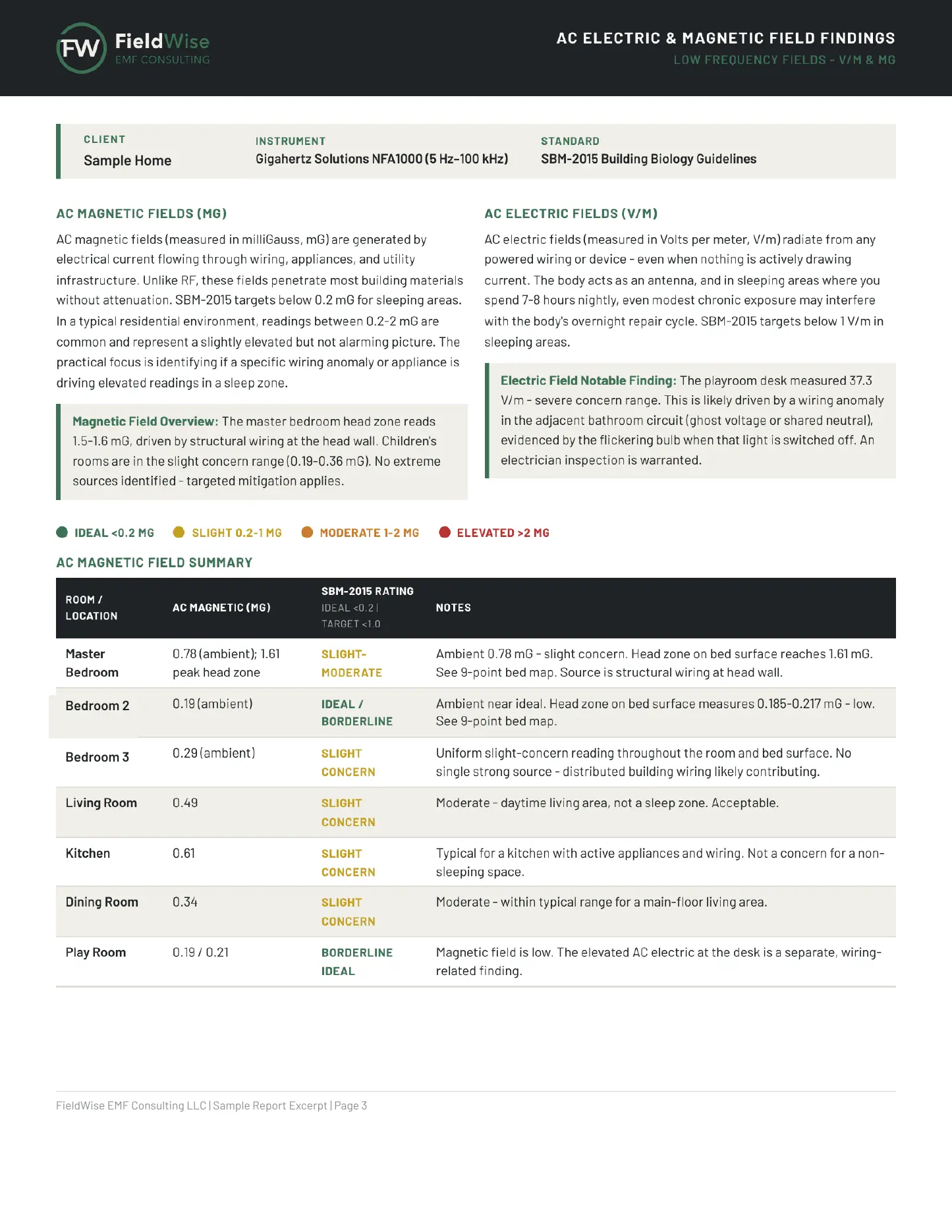
Every assessment includes a written summary and recommendations referenced against Building Biology SBM-2015 classifications.

RF Assessment
$350
60–90 minutes
Wi-Fi, cell signal, smart meters, and RF sources across your space, with a written summary and practical recommendations.
Circadian & Lighting Assessment
$350
60–90 minutes
Full spectrum analysis of your workspace or treatment rooms: color temperature, melanopic lux, blue light percentage, and flicker.
Extended Monitoring is also available as an add-on for spaces with equipment running around the clock.
Already a Referral Partner, or Thinking About It?

Here's how it works in practice.

A chiropractor books an assessment for her own treatment rooms. While we're talking, she mentions she has patients who ask about EMF in their homes, especially parents worried about kids' bedrooms. From there, it's simple: she can send those patients my way, and I can do the same when a client of mine mentions they're dealing with something a chiropractor would actually help with.

No formal contract, no obligation, just two local practices sending people to each other when it makes sense. If you're a wellness practitioner and that sounds useful, mention it when you book.

Questions & Answers

What business owners usually ask first.

Do you only work with homes, or businesses too?
Both. The instruments and standards are the same either way. I assess offices, studios, clinics, gyms, restaurants, and other small commercial spaces using the same protocols I use in a home, referenced against Building Biology SBM-2015.
Will this disrupt my business during open hours?
Not if we schedule around it. Most assessments run 60 to 120 minutes depending on the service, and I can work before opening, after closing, or during a slow window if that's easier for your team or clients.
What's different about assessing a treatment room versus a house bedroom?
Not much technically. The measurements and the standard I'm referencing are the same. What's different is the purpose: in a treatment room, the goal is usually to make sure the environment supports whatever regulation or recovery your client came in for, rather than working against it.
Do you handle workplace safety compliance or exposure limits?
No. That's a separate field with its own credentials, industrial hygiene, ICNIRP standards, and so on, and it's not what FieldWise offers. If you need that kind of compliance work, I'm happy to point you toward it. What I offer is a data-first look at what's actually present in your space, for owners who want to understand their environment rather than meet a regulatory threshold.
Can I use the report with my own clients?
Yes. The report is yours. Many wellness practitioners use it as something they can reference when clients ask about their own environment, since it's already in the same measurement-based language they're likely already using.
I'm not sure if I need the RF assessment, the lighting assessment, or both. How do I decide?
Measuring only one field rarely gives the full picture, especially if the goal is a genuinely thriving space rather than just ruling one thing out. RF and light interact with the body differently, and a space can look fine on one and still be working against you on the other. If you're not sure where to start, a quick call is often the fastest way to figure out what's actually worth measuring in your space.
Ready to Get Started?

Book a discovery call to talk through your space.

Or send a message with a bit about what you run, and I'll follow up.