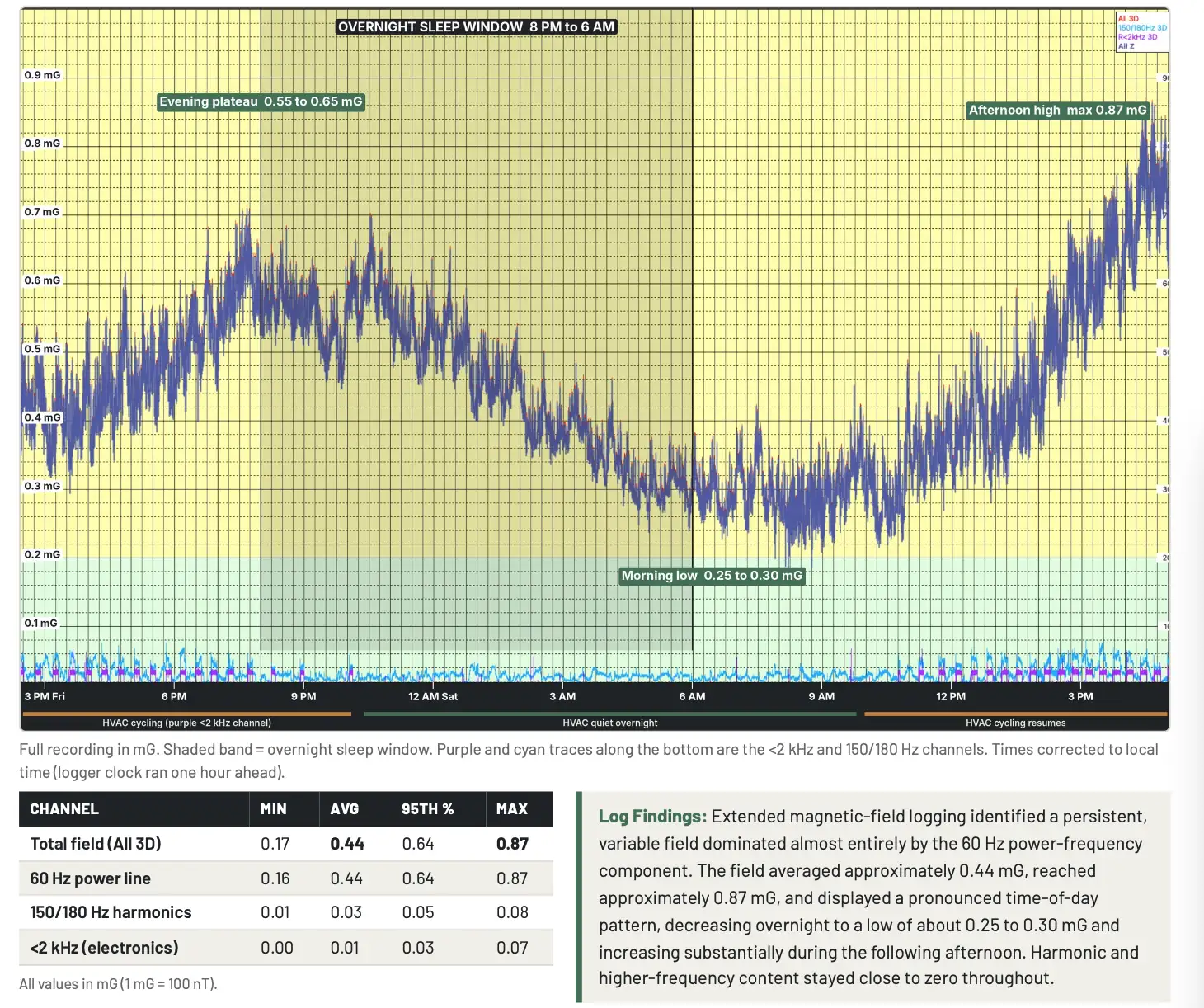
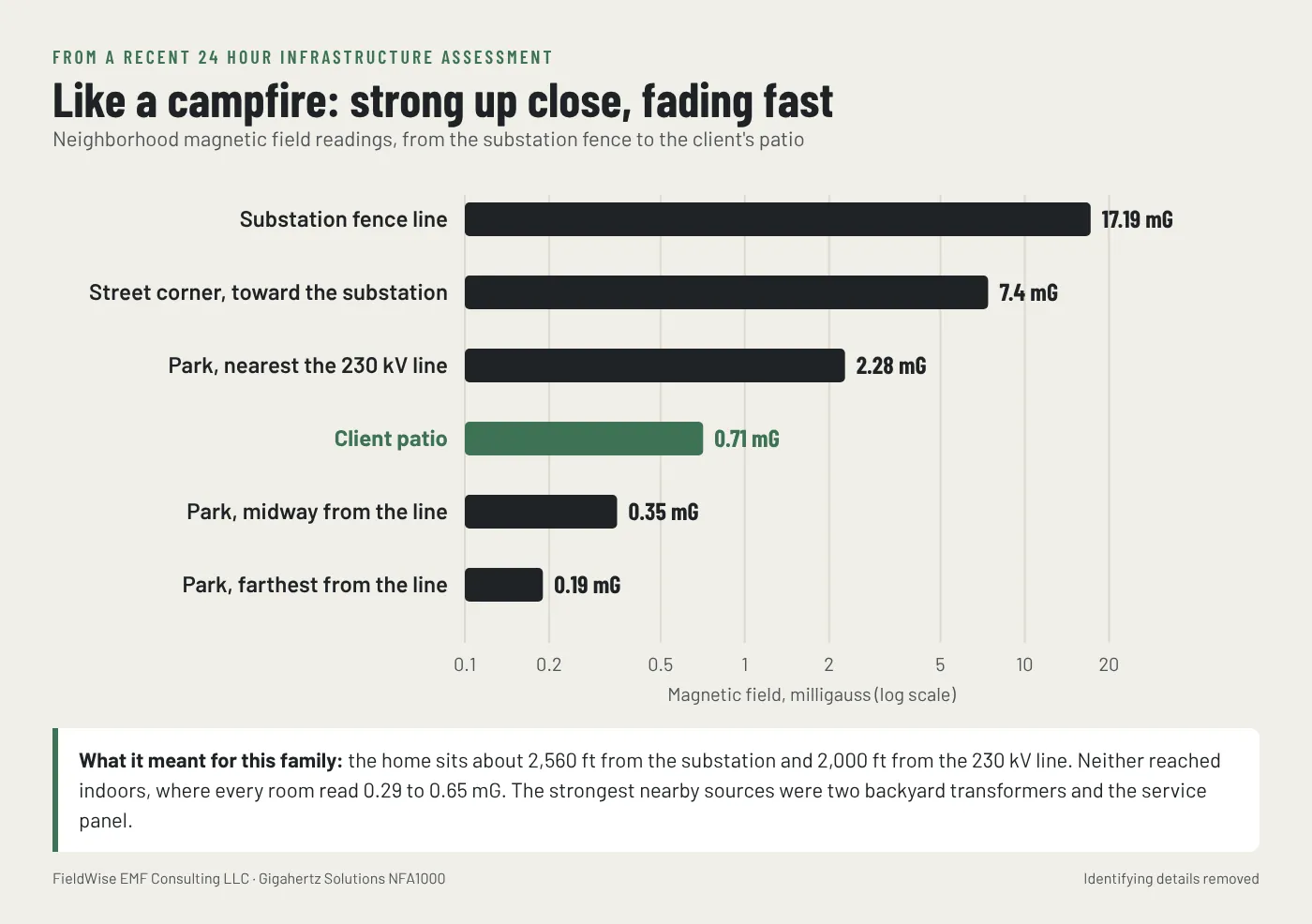
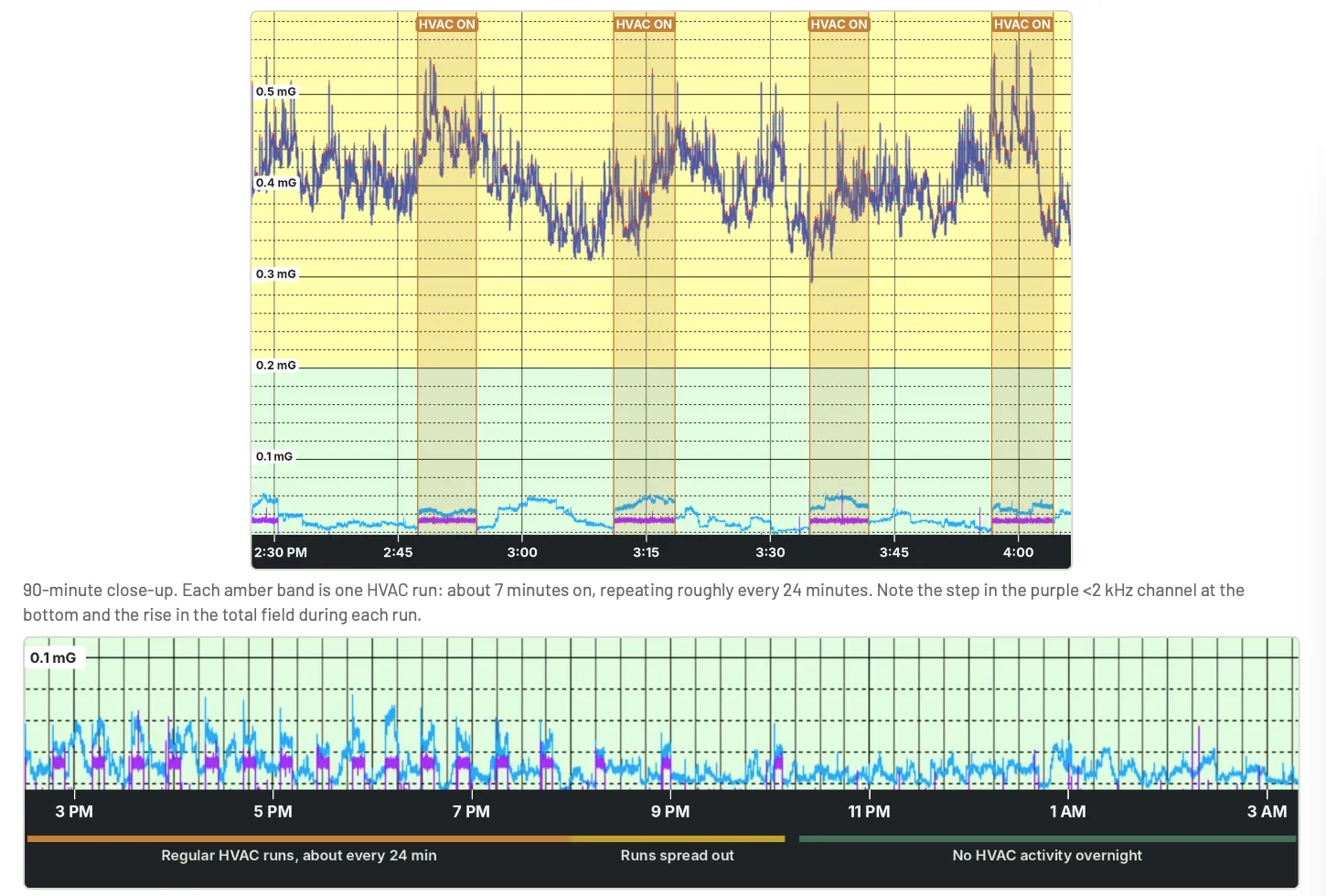
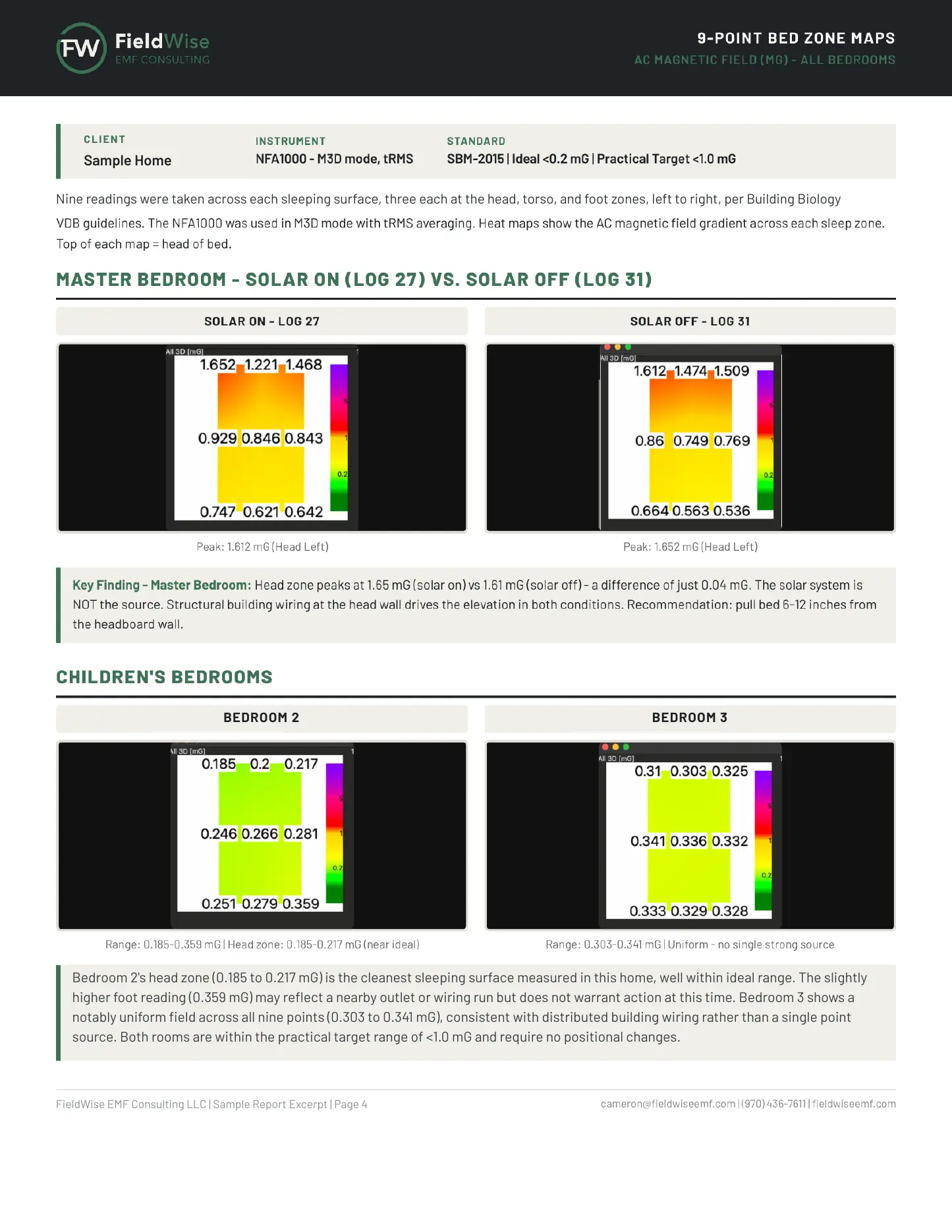
Researchers have measured homes near transmission lines, transformers and cell towers for decades. These findings are why the 24 Hour Infrastructure Assessment measures over a full day, room by room.
Power linesHomes near a big line averaged 7.1 mG, even during sleep
Adults living near a 735 kV transmission line wore meters for 24 hours. Their homes averaged 7.1 mG (6.8 mG during sleep), compared with 1.6 mG (1.1 mG during sleep) for people living far from any line. The field rose and fell with the electrical load on the line.
Levallois P, et al. Environmental Health Perspectives, 1995. Read the study
Fields and lightSteady fields plus low light: lower melatonin
In 142 electric utility workers, those with the most steady magnetic field exposure had lower levels of a melatonin metabolite after work. The effect was stronger in workers who also got the least light during the day, which is why light and fields are worth measuring together.
Burch JB, et al. American Journal of Epidemiology, 1999. Read the study
World Health OrganizationMagnetic fields are classified as possibly carcinogenic
The WHO’s International Agency for Research on Cancer classifies power frequency magnetic fields as Group 2B, possibly carcinogenic to humans. The classification rests mainly on studies linking long term average fields above about 3 to 4 mG with childhood leukemia.
IARC Monographs, Volume 80, 2002. Read the study
Power linesHigher childhood leukemia rates near high voltage lines
A large UK study found a relative risk of 1.69 for childhood leukemia among children born within 200 m of high voltage lines, and 1.23 at 200 to 600 m. The authors noted the pattern reached farther than magnetic fields alone would explain, so the cause is still unclear.
Draper G, et al. BMJ, 2005. Read the study
TransformersApartments above a transformer measured 3 to 6 times higher
In 41 apartments across 10 buildings with indoor transformer stations, apartments directly above the transformer averaged 4 mG, while all other apartments averaged 0.6 to 1.2 mG. What sits under or beside a room matters.
Hareuveny R, et al. Journal of Exposure Science and Environmental Epidemiology, 2011. Read the study
Cell towersDistance alone doesn’t predict cell tower exposure
In 354 homes within 250 m of a cell tower, the tower was the main wireless source in 64% of them. Exposure depended on window position, line of sight to the antenna and which floor the home was on, not just distance.
De Giudici P, et al. Environmental Research, 2020. Read the study
Research on EMF and health is still developing, and some findings are mixed. FieldWise reports what is measured in your space, compared to Building Biology SBM-2015 guidelines. It does not diagnose or treat any condition. That is exactly why a 24 hour measurement beats a guess. See the full research library →